

When sparks are flying and heat levels spike, the last thing any welder wants to question is their protective gear. A welder jacket isn’t just part of a uniform it’s a frontline safety barrier that absorbs heat, blocks spatter, and reduces the risk of serious burns. Under extreme welding conditions, jacket performance isn’t theoretical. It’s tested every day in fabrication shops, shipyards, pipelines, and repair sites.
This article breaks down how welder jackets actually perform under high heat, what separates reliable protection from weak points, and how experienced welders choose the right jacket for the job not the catalog photo. The goal here isn’t to sell gear, but to help you understand what works, what doesn’t, and why it matters.
Why Welder Jacket Performance Matters in High-Heat Work
Welding environments are unpredictable. Even controlled shop settings can produce sudden bursts of spatter or radiant heat that overwhelm inadequate protection. Under extreme conditions, clothing failures happen fast and consequences are immediate.
Common high-heat scenarios include:
- Stick welding with heavy slag
- Flux-core welding with sustained spatter
- Overhead or vertical welding
- Confined spaces with heat buildup
- Long-duration welds without cooldown periods
In these conditions, jacket material, construction, and fit all determine whether heat is deflected—or transferred to skin.
What Defines Extreme Welding Heat?
Not all welding heat is equal. Extreme heat exposure usually involves a combination of factors:
- Radiant heat from arcs and molten metal
- Direct spatter contact on sleeves and chest
- Sustained exposure time rather than brief contact
- Limited airflow that traps heat
A welding jackets that performs well during short TIG welds may fail quickly during stick or flux-core jobs. Matching jacket capability to exposure level is the foundation of real protection.
Types of Welding Jackets and How They Perform
Leather Welding Jackets
A leather welding jacket remains the benchmark for extreme heat environments. From hands-on use, leather consistently outperforms fabric when sparks are constant and spatter is heavy.
Strengths under extreme heat:
- High resistance to burn-through
- Slower heat transfer to skin
- Excellent spark deflection
- Durable under repeated exposure
Limitations:
- Heavier than fabric jackets
- Reduced airflow
- Heat buildup during long shifts
Leather is often chosen for overhead welding or jobs where molten metal frequently lands on the upper body.
Flame-Resistant Fabric Jackets
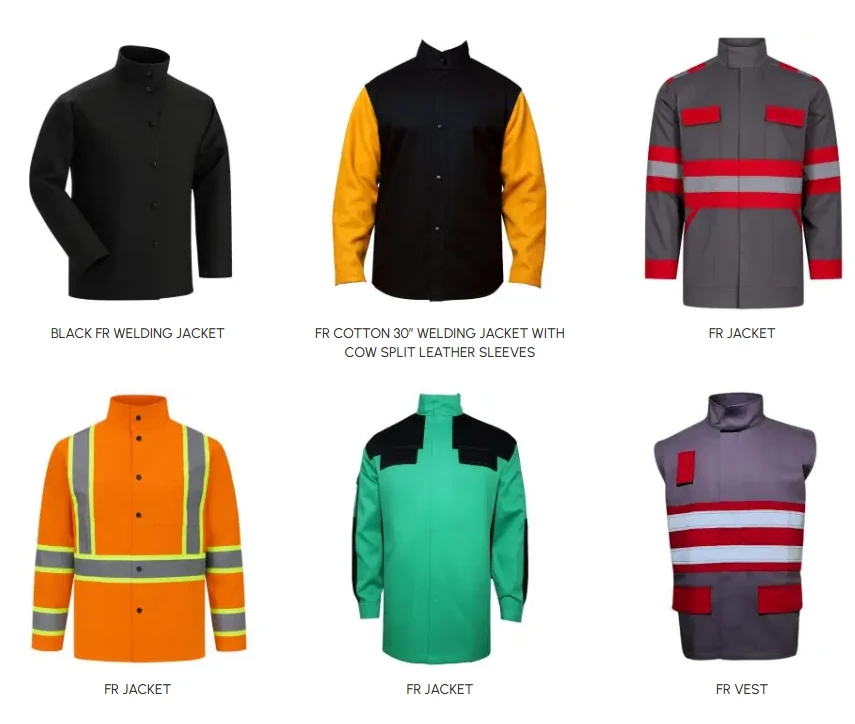
FR fabric options—often referred to simply as an FR Jacket—are common in lighter welding applications. You’ll frequently see shop-standard colors like a Black FR Welding Jacket or Green FR Welding Jacket.
Strengths:
- Lighter weight
- Better breathability
- Easier mobility
Limitations under extreme heat:
- Fabric can char or thin quickly
- Less protection against heavy spatter
- Shorter lifespan in harsh conditions
Fabric jackets work well for TIG welding and controlled MIG work, but many welders switch to leather once exposure intensifies.
Layered and Hybrid Protection
Some professionals use layered setups:
- FR jacket with a FR Vest for added chest protection
- Leather sleeves paired with fabric bodies
- Jackets combined with aprons for lap coverage
This approach balances mobility and protection, but only works when layers are compatible and flame-resistant.
Key Performance Factors That Matter in Real Jobs
- Material Thickness and Density
Thicker leather or tightly woven FR fabric resists heat transfer longer. Thin jackets may look adequate but fail quickly under spatter.
- Seam Construction
Stitching is often a weak point. Under heat, poor seams burn through faster than panels.
Experienced welders look for:
- Reinforced seams
- Flame-resistant thread
- Minimal exposed stitching
- Sleeve and Collar Design
Heat injuries often happen at gaps:
- Loose cuffs
- Short sleeves
- Open collars
A jacket that fully seals exposed areas performs far better under extreme conditions.
- Fit and Coverage
Too loose, and sparks enter the jacket. Too tight, and movement suffers.
A good fit:
- Covers the waist when arms are raised
- Allows full range of motion
- Prevents material bunching
Benefits and Limitations of Welder Jackets Under Extreme Heat
Benefits
- Reduces burn risk to torso and arms
- Protects against radiant heat fatigue
- Improves confidence and focus
- Supports long-term injury prevention
Limitations
- No jacket is fireproof
- Improper use negates protection
- Heat stress becomes a factor
- Requires maintenance and replacement
Understanding these limits helps welders work smarter, not recklessly.
Practical Considerations Before Choosing a Welder Jacket
Match the Jacket to the Welding Process
A common mistake is using one jacket for everything. In practice:
- Leather for stick, flux-core, overhead
- FR fabric for TIG and lighter MIG
- Layered protection for mixed tasks
Consider the Work Environment
Outdoor wind, confined spaces, or high ambient temperatures change how jackets perform.
Plan for Heat Management
Extreme heat doesn’t just burn—it exhausts. Some welders rotate jackets or take scheduled cooldowns to manage fatigue.
Common Mistakes That Reduce Jacket Performance
Even high-quality jackets fail when misused. The most common errors include:
- Wearing synthetic base layers underneath
- Leaving jackets unbuttoned or partially open
- Using damaged or cracked leather
- Assuming “short welds” don’t require full protection
- Ignoring jacket shrinkage after washing
From incident reports, many burn injuries occur during rushed or routine jobs—not complex ones.
Expert Tips From the Field
- Always inspect jackets before shifts
- Replace gear once material thins or stiffens
- Store leather away from moisture and oil
- Don’t modify sleeves or collars
- Use aprons for added lower-body protection
These habits extend jacket life and improve real-world performance.
Real-World Use Cases
Heavy Fabrication Shops
Leather jackets dominate where spatter is constant and heat exposure is prolonged.
Pipeline and Field Welding
Unpredictable angles and wind make full coverage critical.
Training Facilities
New welders benefit from higher protection while learning heat control.
Welder Jackets as Part of a Safety System
A welder jacket doesn’t work alone. Helmets, gloves, aprons, and base layers all affect overall protection. Gaps in any part of the system increase risk.
For a broader look at how protective equipment works together, this guide on Safety Gear explains why compliance and real-world performance must align.
People Also Asked
Do welder jackets really prevent burns?
They reduce burn risk significantly, but only if properly selected and used for the job.
Is leather always safer than FR fabric?
For extreme heat and heavy spatter, leather outperforms fabric; for lighter welding, FR fabric is sufficient.
How long does a welder jacket last?
Leather jackets can last several years with care; FR fabric jackets may need replacement sooner under heavy use.
Can I wear a hoodie under a welding jacket?
No, synthetic layers can melt and cause serious burns.
What Welders Say From the Job
Leather is heavier, but I trust it when sparks are flying nonstop.
Fabric jackets work until the heat ramps up—then leather makes sense.
The burns I’ve seen usually happen when someone skips the jacket.
Final Thoughts: Performance Is Proven Under Pressure
A welder jacket proves its value only when heat levels climb and mistakes carry consequences. Under extreme welding heat, material choice, construction quality, and proper use matter far more than comfort or cost.
The most experienced welders don’t ask whether protection is necessary—they ask whether it’s enough for the job at hand. When safety decisions are grounded in real-world conditions, injuries drop and confidence rises.
About the Editorial Team
This article was written by the Uniqent Enterprises editorial team, drawing on hands-on experience with industrial safety gear and real welding environments. The focus is practical, field-tested insight what performs under pressure, what fails, and how professionals can make safer, more informed choices on the job.